
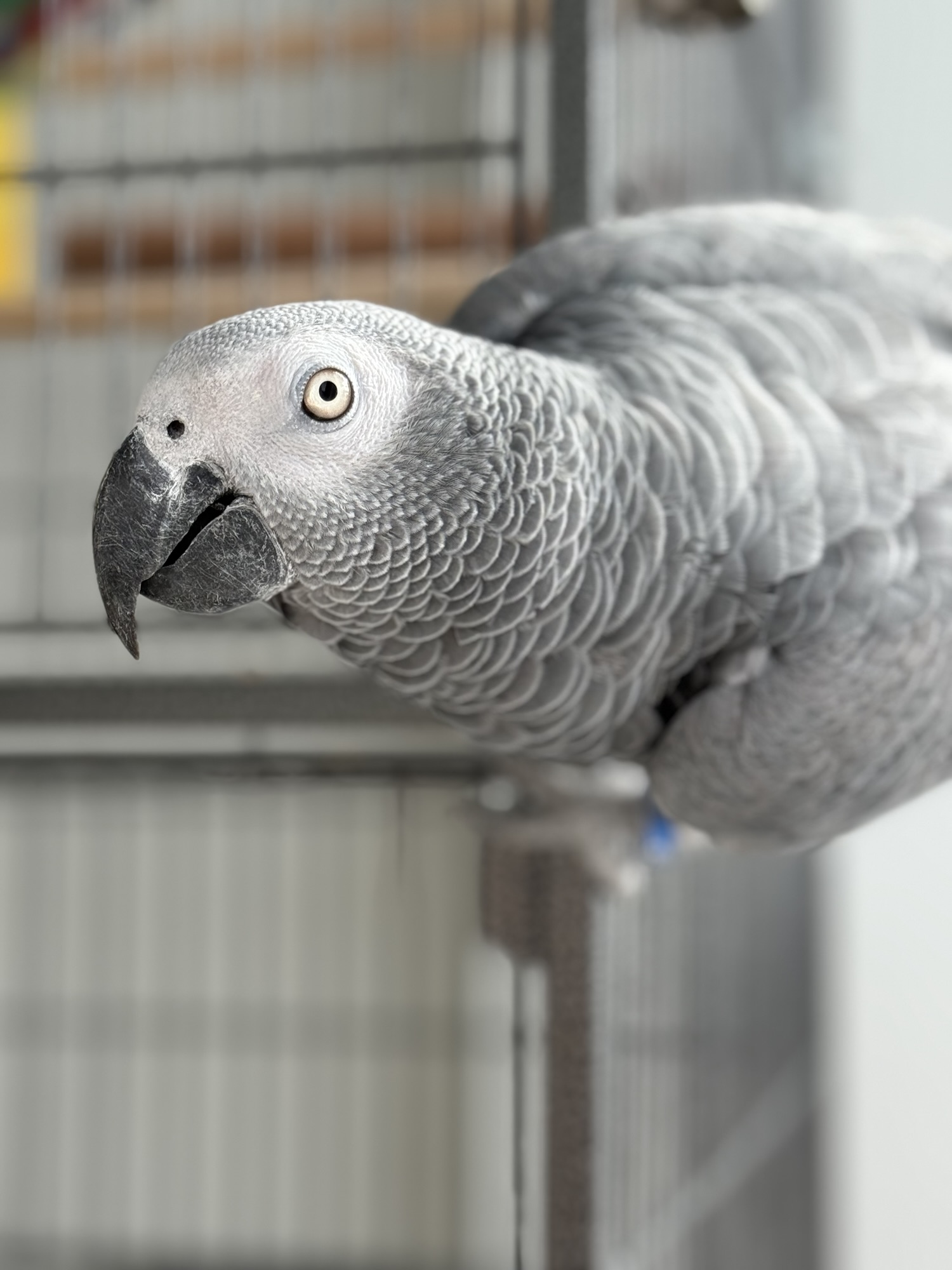

African Greys: Extraordinary Talking Birds with Real Vocal Talent
African Grey parrots are widely recognized as excellent talking birds — not just because they mimic words, but because they show context, tone, and emotional intelligence in their speech.
Baby Zeus shows this beautifully:
- “You’re super!” with excitement
- “I’m so proud” in a nurturing tone
- “Fresh water?” with question intonation
- “Hey babe” as a greeting
- “543” with perfect rhythm
These aren’t random noises.
They are intentional expressions, shaped by intelligence and emotional awareness.
⭐ Where Baby Zeus Heard Real Parrot Voices
Baby Zeus developed his speech abilities by listening to real parrots, not just humans. His vocal environment played a huge role in shaping his clarity, tone, and rhythm.
🟢 1. Real Parrot Companions — Especially Ozzie
Zeus interacted with Ozzie, the Indian Ringneck.
This provides him with:
- natural parrot tone
- conversational back-and-forth
- pacing and rhythm
- vocal play and mimicry
Parrots learn incredibly well from each other — just like children learning language together.
🟢 2. Real Parrot Voices on YouTube
Before Zeus began speaking clearly, he regularly heard:
- talking African Greys
- Ringnecks practicing words
- whistling routines
- long parrot speech training videos
These gave him:
- species-appropriate pitch
- realistic vocal patterns
- natural phrasing
- correct tone and rhythm
Baby Zeus learned real parrot speech from two places: daily interaction with companion birds like Ozzie the Indian Ringneck, and exposure to real parrot voices on YouTube long before he began speaking clearly. Hearing other parrots helped him learn pitch, rhythm, and natural phrasing much faster than human voices alone.
This is one of the BIG reasons Baby Zeus speaks with such excellent clarity.
What Makes African Greys Excellent Speakers?
1. Remarkable Intelligence
African Greys have the cognitive abilities of a young child (2–5 years old).
They can:
- learn hundreds of words
- understand phrases
- mimic tone
- respond in context
- recognize emotions
This is why Baby Zeus communicates with personality — not just sound.
2. Highly Flexible Syrinx Control
Parrots use the syrinx, a two-chamber vocal organ that allows advanced control.
African Greys can:
- copy consonants
- match vowel sounds
- imitate emotional tone
- produce clear, crisp speech
Zeus demonstrates this with:
His clarity reflects exceptional syrinx control.
3. Emotional Voice Imitation
African Greys excel at copying emotion, not just words.
Baby Zeus consistently uses tone:
- affection
- excitement
- curiosity
- humor
This emotional delivery is part of what makes him so expressive.
How Fast Do African Greys Learn?
Many African Greys begin talking between 6–18 months, depending on:
- exposure
- interaction
- training
- enrichment
Baby Zeus learned unusually fast because he:
- heard parrot voices (not just humans)
- practiced daily
- listened carefully
- had strong vocal role models
- was encouraged enthusiastically
He learns in clusters of words, not one at a time.
Why Baby Zeus Stands Out
🟣 Clear articulation
Zeus’s words are crisp and understandable.
🟣 Emotional expression
His “so proud” and “super!” carry real tone.
🟣 Intonation
He uses rising pitch for questions like “You want fresh water?”
🟣 Rhythm
🟣 Rapid vocabulary growth
He picks up new words quickly and uses them consistently.
How Your Bird Can Learn Like Baby Zeus
- Use real parrot voice training
- Start with easy words
- Practice daily
- Use 3× repetition
- Praise every attempt
Your method makes it easy for any bird to progress.
The Aviary Lexicon: A Parrot Learning Resource
Ivyleaguebirdtv.com’s Aviary Lexicon includes:
- every word Zeus says
- categorized vocabulary
- audio examples
- real recordings
- links to tutorials
It is the first and only interactive parrot vocabulary dictionary based on real recordings.
Final Thoughts
African Greys are excellent talking birds because they combine:
- intelligence
- syrinx flexibility
- emotional mimicry
- strong memory
- desire to bond with humans
Baby Zeus embodies all of these traits beautifully.
And the key to his success is simple:
He learned from real parrots — and now, your bird can too
Leave a Reply